The RabbitMQ producer consumer model offers a lightweight yet reliable alternative to Kafka for asynchronous messaging.
In previous articles, https://dataget.ai/wp-admin/post.php?post=511&action=edit and https://dataget.ai/wp-admin/post.php?post=514&action=edit
, we examined how Kafka achieves high throughput through a distributed log architecture.
However, Kafka’s complexity and operational cost make it less suitable for scenarios that require flexible routing or lightweight deployment.
In contrast, RabbitMQ follows a very different design philosophy. It focuses on message reliability, routing flexibility, and fine-grained consumer control, making it a popular choice for microservices and traditional enterprise systems.
What Is RabbitMQ?
RabbitMQ is an open-source message broker implemented in Erlang, based on the AMQP (Advanced Message Queuing Protocol).
Originally developed for financial systems, RabbitMQ emphasizes reliable delivery and flexible message routing, which aligns naturally with the RabbitMQ producer consumer model.
Key advantages include:
- Reliable Messaging Supports acknowledgments, persistence, and transactions to prevent message loss.
- Flexible Routing Uses exchanges and bindings to route messages with precision.
- Multi-Protocol Support In addition to AMQP, RabbitMQ supports MQTT, STOMP, HTTP, and WebSocket.
- Plugin Ecosystem A rich plugin system allows easy extension and integration.
- Lightweight Deployment Runs efficiently even in resource-constrained environments.
- High Availability Supports mirrored queues and quorum queues for fault tolerance.
For official details, see the
👉RabbitMQ Documentation: https://www.rabbitmq.com/documentation.html — RabbitMQ’s being significantly distinct from Kafka’s.
Core Architecture
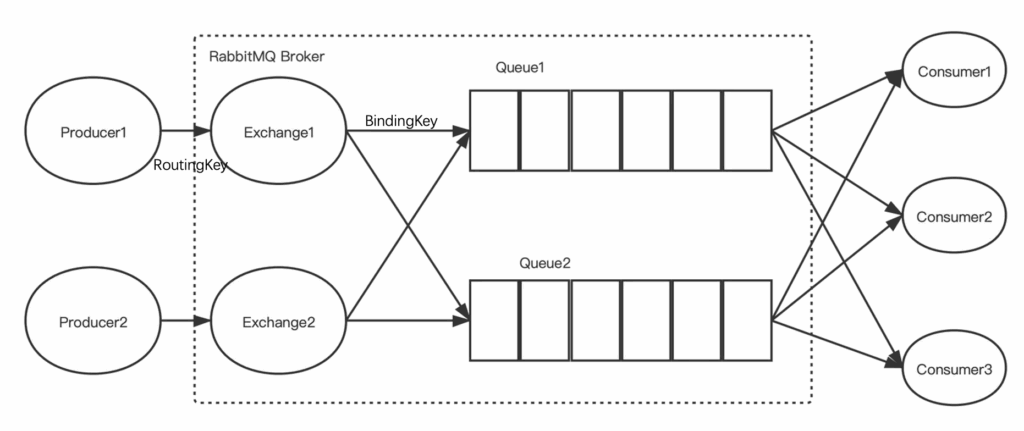
RabbitMQ has a more intricate core architecture than Kafka. The architecture is illustrated below:
Producer
A Producer is a message sender. After creating a message, it publishes it to a RabbitMQ Broker. A message generally consists of:
- Body (Payload) – The business data.
- Metadata – Including the exchange name and routing key, which RabbitMQ uses to route the message to the appropriate consumers.
RoutingKey
A RoutingKey is used to determine how the message should be routed through the exchange.
RabbitMQ Broker
The Broker is the RabbitMQ server instance responsible for receiving, routing, and storing messages.
Exchange
An Exchange receives messages from producers and routes them to one or more queues based on routing rules. If routing fails, the message may be returned to the producer or discarded.
RabbitMQ supports four types of exchanges:
- fanout
Broadcasts all messages to every queue bound to it — similar to pub-sub. - direct
Routes messages to queues whose binding key exactly matches the routing key. - topic
Similar todirect, but uses wildcards in the routing key for flexible pattern matching. - headers
Does not rely on routing keys; routes messages based on matching message headers.
BindingKey
A BindingKey links a queue to an exchange. It defines how the broker should route messages from the exchange to the queue.
Queue
A Queue is an internal buffer in RabbitMQ that stores messages until they are consumed. Unlike Kafka, where each consumer gets its own copy of the data (depending on consumer group), RabbitMQ distributes messages across multiple consumers connected to the same queue, load-balancing the workload.
Consumer
A Consumer pulls messages from a queue and can acknowledge them to ensure reliable delivery.
Getting Started
Now that we’ve covered RabbitMQ’s goals, features, and architecture, let’s see it in action.
Producer Code (Java)
public class RabbitProducerDemo {
    private static final String EXCHANGE_NAME = "exchange_demo";
    private static final String ROUTING_KEY = "routingkey_demo";
    private static final String QUEUE_NAME = "queue_demo";
    private static final String IP_ADDRESS = "127.0.0.1";
    private static final int PORT = 5672;

    public static void main(String[] args) throws IOException, TimeoutException {
        ConnectionFactory factory = new ConnectionFactory();
        factory.setHost(IP_ADDRESS);
        factory.setPort(PORT);
        factory.setUsername("admin");
        factory.setPassword("root");

        Connection connection = factory.newConnection();
        Channel channel = connection.createChannel();

        channel.exchangeDeclare(EXCHANGE_NAME, "direct", true, false, null);
        channel.queueDeclare(QUEUE_NAME, true, false, false, null);
        channel.queueBind(QUEUE_NAME, EXCHANGE_NAME, ROUTING_KEY);

        String message = "Hello RabbitMQ!";
        channel.basicPublish(EXCHANGE_NAME, ROUTING_KEY,
                MessageProperties.PERSISTENT_TEXT_PLAIN, message.getBytes());

        channel.close();
        connection.close();
    }
}
Consumer Code (Java)
public class RabbitConsumerDemo {
    private static final String QUEUE_NAME = "queue_demo";
    private static final String IP_ADDRESS = "127.0.0.1";
    private static final int PORT = 5672;

    public static void main(String[] args) throws IOException, TimeoutException, InterruptedException {
        Address[] addresses = { new Address(IP_ADDRESS, PORT) };
        ConnectionFactory factory = new ConnectionFactory();
        factory.setUsername("admin");
        factory.setPassword("root");

        Connection connection = factory.newConnection(addresses);
        Channel channel = connection.createChannel();
        channel.basicQos(64); // prefetch count

        channel.basicConsume(QUEUE_NAME, new DefaultConsumer(channel) {
            @Override
            public void handleDelivery(String consumerTag,
                                       Envelope envelope,
                                       AMQP.BasicProperties properties,
                                       byte[] body) throws IOException {
                System.out.println("Received message: " + new String(body));
                try {
                    TimeUnit.SECONDS.sleep(1); // simulate processing
                } catch (InterruptedException e) {
                    e.printStackTrace();
                }
                channel.basicAck(envelope.getDeliveryTag(), false); // manual ack
            }
        });

        TimeUnit.SECONDS.sleep(10); // keep app running
        channel.close();
        connection.close();
    }
}
Common Use Cases
RabbitMQ is commonly used in the following scenarios:
- Service Decoupling
Enables asynchronous communication between microservices, reducing tight coupling. - Delayed Tasks
Useful in scenarios like order timeouts, scheduled notifications, etc., via TTL and dead-letter queues. - Transactional Compensation
Helps implement eventual consistency and distributed transactions alongside databases. - Centralized Logging
Collect logs from various services for aggregation, analysis, and visualization.
Conclusion
Unlike Kafka, which is designed for extreme throughput and large-scale distributed processing, RabbitMQ excels in lightweight, reliable, and flexible message delivery — especially in scenarios requiring routing logic, delayed tasks, or transactional reliability.
RabbitMQ represents an alternative design philosophy for implementing the producer-consumer model — one that prioritizes flexibility and reliability over raw throughput.